Component Aerodynamics
NASA/pyCycle generic component maps provide the aerodynamic basis for fan, compressor, and turbine performance and are scaled to the engine being modeled.
turbofanmodeling.org
Real-Time Physics-Based Turbofan Modeling Framework
TurboFanModel is a real-time system-level model of modern turbofan engine behavior. The framework combines aerodynamic component maps, Brayton-cycle thermodynamics, shaft work balance, fuel control, inlet and exhaust calculations, and numerical integration of transient spool dynamics into a self-contained engine model.
Development and test environment
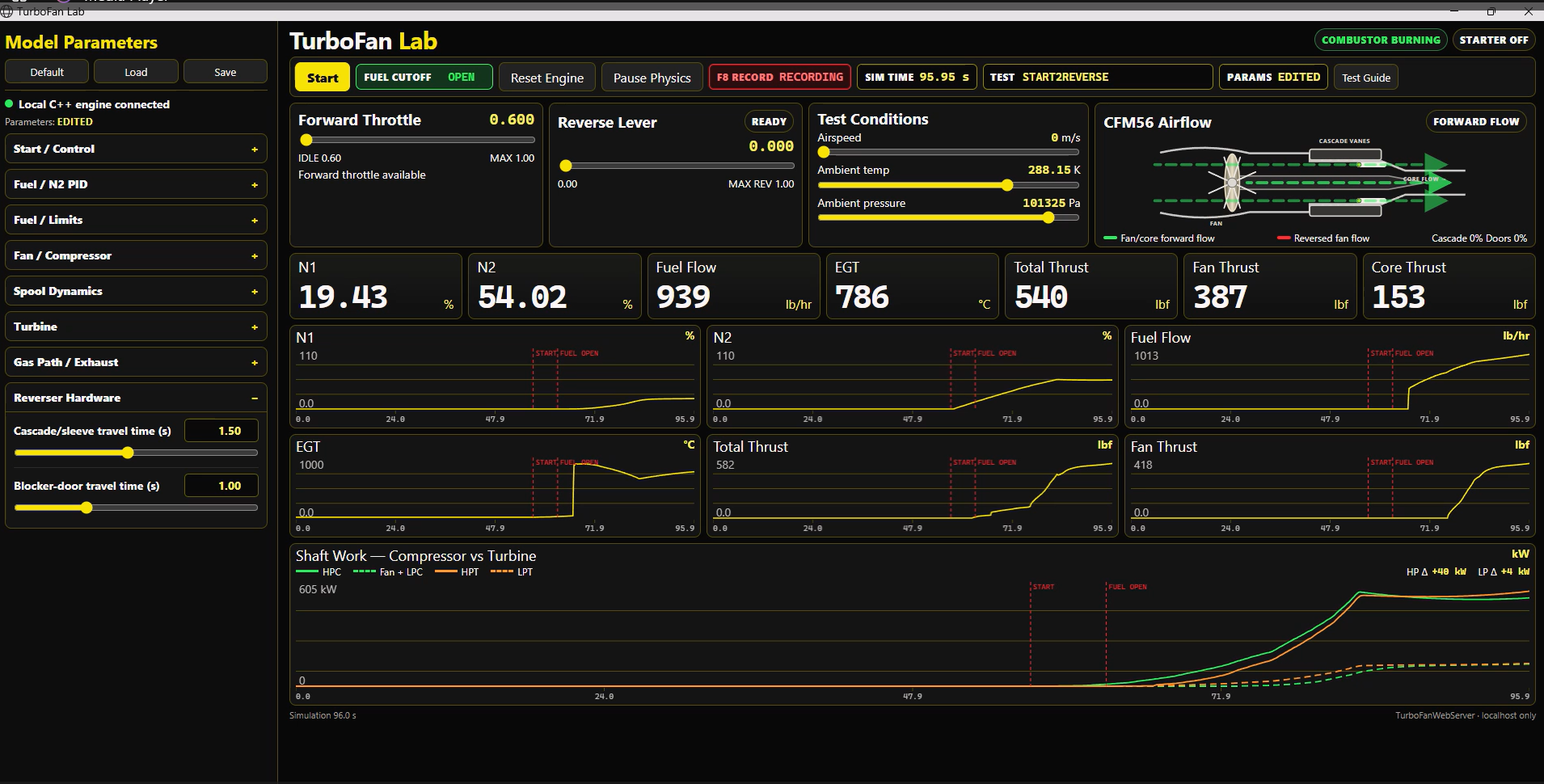
TurboFanLab provides real-time access to engine controls, operating conditions, spool response, fuel flow, EGT, thrust, and shaft-work relationships during model development and validation.
Modeling method
NASA/pyCycle generic component maps provide the aerodynamic basis for fan, compressor, and turbine performance and are scaled to the engine being modeled.
Pressure, temperature, mass flow, fuel addition, turbine work, and exhaust conditions are calculated through the coupled engine flow path.
HP and LP spool response is formulated with differential equations and numerical integration techniques such as fourth-order Runge–Kutta.
Engine-definition values are identified as published, calculated, estimated, or tuned so that assumptions and validation changes remain visible.
Current demonstration
The first full reference-engine demonstration is based on the GE90-115B. Publicly available GE, NASA, certification, and research data are being used to establish the master parameter set and convert the NASA/pyCycle Fan, LPC, HPC, HPT, and LPT map surfaces to GE90 design targets.
Planned validation progresses from static TurboFanLab tests to transient and altitude/Mach operation, followed by aircraft-level flight testing with a Boeing 777 model using available flight-simulation programs such as FlightGear/JSBSim.
Potential applications
The engine core is intended to remain independent of the host application. External interfaces can supply flight/environmental conditions and control inputs while receiving thrust, instrumentation, and detailed engine-state telemetry.
Current review material
These are interim development documents and will be revised as the GE90 component maps and validation results mature.
Point of contact
Questions, research interest, or collaboration inquiries are welcome.